
|
| Photography / Travel |
 |
|
|
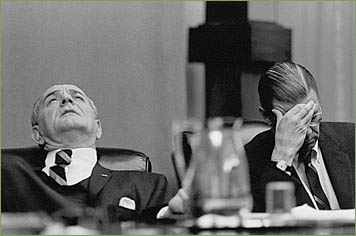 President Johnson and Secretary of Defense McNamara (1965) |
The Whiz Kids: How 10 Men Saved America
by Tim Darling (email) - July, 2008.
|
 In 2008, I read John Byrne’s wonderful book, The Whiz Kids: Ten Founding Fathers of American Business - and the
Legacy They Left Us. (John is perhaps best known for his later biography of Jack Welch, Jack: Straight from the Gut.)
This is basically just a brief summary of the book with a few original thoughts and some notes from other sources
added.
In 2008, I read John Byrne’s wonderful book, The Whiz Kids: Ten Founding Fathers of American Business - and the
Legacy They Left Us. (John is perhaps best known for his later biography of Jack Welch, Jack: Straight from the Gut.)
This is basically just a brief summary of the book with a few original thoughts and some notes from other sources
added.
 Before Tex took over Stat Control, numbers were guessed at and assumptions were rarely questioned in the Air Force.
No one even knew how many personnel were serving. Stat Control sent men out to count the number of planes in each
hangar and the number of spare parts available at each airfield. The number of bombs that could be delivered to a
target per gallon of fuel per plane type were calculated and contrasted. Knowledge is power and Tex’s team quickly
earned the power: they were able to enforce high-level decisions based on facts and analyses that no one else had.
Before Tex took over Stat Control, numbers were guessed at and assumptions were rarely questioned in the Air Force.
No one even knew how many personnel were serving. Stat Control sent men out to count the number of planes in each
hangar and the number of spare parts available at each airfield. The number of bombs that could be delivered to a
target per gallon of fuel per plane type were calculated and contrasted. Knowledge is power and Tex’s team quickly
earned the power: they were able to enforce high-level decisions based on facts and analyses that no one else had.
 In many ways, Tex’s group were among the first management consultants.
They made decisions based on facts instead of intuition (as they didn’t have any intuition or industry knowledge).
They didn’t really care about the product that Ford was making; to them, Ford was a collection of statistics. They
could just as easily have been working for a firm that manufactured soap or televisions. Additionally, the original
agreement among the ten of them was that no one would leave the group for at least the first one and a half to two
years to allow the group to become maximally productive. The average MBA who goes to work for a management consultant
firm today stays for that exact amount of time.
6
In many ways, Tex’s group were among the first management consultants.
They made decisions based on facts instead of intuition (as they didn’t have any intuition or industry knowledge).
They didn’t really care about the product that Ford was making; to them, Ford was a collection of statistics. They
could just as easily have been working for a firm that manufactured soap or televisions. Additionally, the original
agreement among the ten of them was that no one would leave the group for at least the first one and a half to two
years to allow the group to become maximally productive. The average MBA who goes to work for a management consultant
firm today stays for that exact amount of time.
6
 Tex resigned in 1953 and dazzled and then dismayed Wall Street as the head of Litton Industries in the 1960s and 1970s.
Litton Industries started as a collection of small technology firms; if the Whiz Kids had paved new ground by making a
science out of business in the previous ten years, Tex was now paving new ground by making a business out of science.
Tex resigned in 1953 and dazzled and then dismayed Wall Street as the head of Litton Industries in the 1960s and 1970s.
Litton Industries started as a collection of small technology firms; if the Whiz Kids had paved new ground by making a
science out of business in the previous ten years, Tex was now paving new ground by making a business out of science.
 What went wrong with Vietnam?
McNamara has since stated that he knew by 1965 that the war in Vietnam was unwinnable militarily.
19
This was an impressive insight at such an early date; the numbers and analyses had served him well. The problem was that
he believed that by simply treading water in Vietnam - ie neither winning nor losing the war - we were preventing the
fall of all of southeast Asia to communism. He believed that once the dominos started to fall in Asia, the Soviet
Union could move their missiles and influence closer and closer to Europe and the US, thus risking a much larger
nuclear war. However, as he realized twenty years later, Southeast Asia didn’t want to fall to the communists.
In Vietnam we were caught in a nationalistic civil war; we were not defending the world against a larger war.
What went wrong with Vietnam?
McNamara has since stated that he knew by 1965 that the war in Vietnam was unwinnable militarily.
19
This was an impressive insight at such an early date; the numbers and analyses had served him well. The problem was that
he believed that by simply treading water in Vietnam - ie neither winning nor losing the war - we were preventing the
fall of all of southeast Asia to communism. He believed that once the dominos started to fall in Asia, the Soviet
Union could move their missiles and influence closer and closer to Europe and the US, thus risking a much larger
nuclear war. However, as he realized twenty years later, Southeast Asia didn’t want to fall to the communists.
In Vietnam we were caught in a nationalistic civil war; we were not defending the world against a larger war.
As an alum of 30 years at Ford and a decade at GM, I am sure that the key flaw of whiz kid/MBA logic is failure to know and anticipate that "every yin has a yang"; eg there will always be secondary consequences of any action, human or product/process. Short form: "S**t happens"; technical version: always there are byproducts. Related scuttlebutt: McNamara was only apptd Pres. of FoMoCo to validate his credentials for Secy of Defense 6 weeks later. HFII detested McNamara's aloof manner, would have never had him as real Co. pres in place. Provenance avail if desired. My MBA was during Arjay reign at Stanford. My class included Susan Packard (now Orr); while her Dad was in Washington as the Dept. of Defense "do-er". Without him to actually make things happen McNamara's ethereal fraudulence would have been evident years & many lost lives earlier. Cheers.
-- Phil Smith, Feb 22, 2009
Hi. I had read about the whiz kids when I was studying for my MBA. Since then I have always wondered what it was like to be part of them....like a club I could only observe...but never be part of. This article revives memory's of that.
-- rahul shah, Aug 5, 2009
Giulio Douhet begat Airpower theory. The experience of applying airpower theory in WWII begat Joseph Heller s "Catch 22." At the same time that "Catch 22" was being published, McNamara and the "whiz kids" were formulating theories of the application of Statistical Process Control (SPC) to warfare and more specifically the counter insurgency campaign in Vietnam. The USAAF strategic air campaign had begotten the "whiz kids" during WWII where the group was part of a management science operation within the USAAF known as Statistical Control, organized to coordinate all the operational and logistical information required to manage the waging of war. McNamara's and the "whiz kids" focus was on kill ratios (which was one American or Vietnamese soldier for every 2.6 Viet Cong or North Vietnamese killed) and People flows abstracted the war into simple numbers that could be fed into the statistical process model and also gave us the "body count." The "whiz kids" and the air war doctrine that emerged from Vietnam begat Effects Based Operations (EBO). EBO was the warfighting theory used by the USA entering into the current conflicts in Iraq and Afghanistan. The theorists of EBO viewed the success of the First Gulf War and the political validation of the press as proof that the Millennium had arrived and the theories of Douhet, Trenchard, Mitchell, The "whiz kids" and those who walked in their footsteps were triumphant and air delivered bombs had become smarter than infantry soldiers. But what really hurts my head is that if the sequence number for the letter of the alphabet is used, "E" becomes 5, "B" becomes "2" and "O" becomes 15, so EBO = 22. I guess no one caught that EBO is equal to 22. So we entered the war in Iraq and Afghanistan caught on 22.
-- Chris Isgrig, Sept 7, 2009
While we may find all kinds of fault with the whiz kids, and there is plenty, it is evident that they knew more than Hnery Ford I did and they saved Ford from failure. There is no doubt that he could have done more. I was employed with Ford for 40 year and I lived through the reign of the whiz kids and I cannot forget how diverse they were in their talents and skills. Creating a cash mangement program and an accounting system earned my respect. Most employees thought Robert McNamara to be fish out of water and could see very little of his merit.
-- gerald adcock, Jun 4, 2012